|
|
|
Original Post By:
DaveM
|
Date: 8/1/2008 4:54:11 PM |
Anyone know why a string (E, in this case) would buzz (especially when played open) after changing strings, but it didn't buzz before the change? (Although the A string buzzed some before the change - and doesn't now?)
It could be me - this is the second time I changed strings.
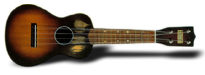
I went from Hilos to Aquilas on a Flea w/plastic board.
Thanks. |
|
|
|
|
|
|
|
|
Posted By:
ToeBone
|
Date: 8/1/2008 11:52:10 PM |
I sometimes get a buzz after changing strings, but never mind that. You might want to check the height of the buzzing string at the nut. Sometimes a skinnier string will sit lower in the notch in the nut and sit too close to the frets.
That same skinnier string can also require less tension to come up to pitch, so it will have a wider vibrating envelope which will cause it to hit a fret. I can't tell you what the difference is between the two brands, but that seems to me what's going on.
|
|
|
|
|
Posted By:
ChefJeff
|
Date: 8/2/2008 8:28:10 AM
(Updated: 8/2/2008 8:28:43 AM)
|
Except that the Flea has a zero fret, which makes it unlikely that the depth of the nut slots is the cause. To confirm that the strings aren't too low, fret a string just behind the third fret wire then try to fit a business card between that string and the first fret (which is the second fret wire from the nut). A typical business card (about .010" thick) should slip in with a little resistance. If it's too tight, that could be the cause of your buzz but then either someone has lowered the saddle (a lot) trying to lower the action or the neck has warped. Given the neck the Flea has and the way it's fastened, that too seems unlikely.
It could be that the nut slots are too wide. Did anyone widen them to accept the Hilos? Or, something might be loose inside. The Flea doesn't have a lot of stuff inside but it does have at least one soundboard brace, which you can reach with your finger with the strings in place.
Good luck.
|
|
|
|
|
Posted By:
Ed B.
|
Date: 8/3/2008 7:50:32 PM |
Puzzling, isn't it? Not that much to go wrong on a Flea. Good suggestion about the width of the nut slots, ChefJeff.
But if the business card check shows the strings to be too low, it wouldn't be because of a low saddle or a warped neck -- by fretting behind the third fret, you isolate both of those problems. In that case, about the only cause could be the zero fret too low or the first fret too high.
The problem might be a low saddle or a warped neck, but you'd need to check for these problems in a different manner.
ChefJeff's other suggestion of checking the bracing is a good idea. When you change the strings you un-stress and then re-stress the top, so if the bracing was just barely hanging on, this would be the time it could pop loose.
A couple of more possibilities: if the ends of the new strings aren't trimmed right, they might be resting lightly against the body of the uke and buzz as you play. Or, if you wind the string onto the tuner wrong, you might not have enough of a break angle behind the nut. Long shots both, but worth checking. Good luck finding the problem!
|
|
|
|
|
Posted By:
ToeBone
|
Date: 8/4/2008 10:58:57 AM |
I still think it's tension that made the difference. I bet if you tuned up to D tuning it wouldn't buzz any more.
But the Flea shouldn't be that sensitive to the string change. Were the saddle or zero fret altered at all? Put Hilos back on tuned to C - does it still buzz? If not, I think you have only one option - to use strings that don't buzz.
|
|
|
|
|
Posted By:
Robbie
|
Date: 8/6/2008 1:31:16 AM
(Updated: 8/6/2008 2:14:04 AM)
|
I think the buzz comes from your mistakenly replacing your E string with a Bee string. That's got to be the reason, 'cause Fleas don't buzz, but Bees do.
Actually, the buzzing may be due to the strings being new. I love the warm sound of Aquillas, but they require a long time to break in, I've found it takes about 2 weeks of playing, & constant retuning between songs as the strings initially stretch so much. They're so sloppy at first, I wouldn't doubt that that could be a big part of your problem. I'd suggest that you play them hard for a couple of weeks, & see if the buzzing doesn't stop after they're stretched in. If there's still a buzz after that, then think about going back to Hilo's or look for one of the situations mentioned above in the previous posts.
|
|
|
|
|
Posted By:
ChefJeff
|
Date: 8/6/2008 7:10:21 PM |
| This may sound silly but is there any chance you're leaving an IMT-500 clipped to the headstock while you go through the new string stretching phase? That tuner's buttons do an amazing imitation of a string buzz, which can cause you to go nuts looking for the cause. Please don't ask me how I know this.
|
|
|
|
|
Posted By:
Ed B.
|
Date: 8/7/2008 5:20:58 AM |
| Oh yeah, I forgot about that one, ChefJeff! It's happened to me too (more than once, I might add).
|
|
|
|
|
Posted By:
DaveM
|
Date: 8/9/2008 5:32:37 PM |
| Thanks for all your responses. I'm learning that a seemingly "simple" instrument can get relatively complicated. It looks like musicguymic (and Elmer) have discovered the same problem (and MGM a solution?) - see "fluke and flea buzz hint..." (as Subject).
|
|
|
|
|
Posted By:
DaveM
|
Date: 8/14/2008 10:21:18 AM |
| I know you've all been waiting to hear how this turned out: I had already tried the paper-in-the-slot trick, but it didn't seem to help. Then last night my daughter (it's her uke) started playing (for the first time in a few days) and said that the uke had been healed. This suggests that Robbie's idea of new strings needing acclimation was the solution, although I'd rather credit my own procrastination in dealing with the problem. But seriously, thanks again for the help - I'm keeping the ideas on file.
|
|
|
|
|
Posted By:
Ed B.
|
Date: 8/14/2008 2:37:42 PM
(Updated: 8/14/2008 2:40:08 PM)
|
Thanks for the update, Dave.
Here's a theory that matches both MGM's observations (Aquila strings are too wide for the slot in the nut) and your experience (the problem goes away after two weeks). It may be that over time the string was compressed slightly by the nut slot, deforming it enough so that it could settle all the way to the bottom of the slot.
But I like your theory of "solved by procrastination" even better.
|
|
|
|