|
|
|
|

|
Uke Yak Fans,
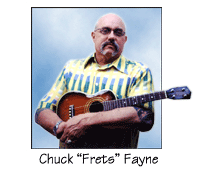
Chuck "Frets" Fayne has been the resident expert for "Uke Yak" since 1998. Since that time he has answered almost 6,000
questions related to vintage ukuleles. Over many years, Chuck assembled his own world-class collection of vintage Hawaiian and Mainland ukes, including some amazing one-of-a-kind pieces. It was Chuck’s collection that made up the majority of the ukes in my book,
"The Ukulele-A Visual History." Although Chuck has retired from the Uke Yak,
his extensive knowledge and unique sense of humor live on in this searchable archive. Enjoy! Search the Uke Yak.
Jumpin’ Jim
2015
|
|
|
|
(Chuck
"Frets" Fayne has answered the following 5919
questions.)
|
 Question asked by:
Steve Wilson
Subject: necks and fretboards
Question: Steve wants to know where to get necks and fretboards and try to make a cigar box uke.
Answer: Steve, there is alot to know about making a uke. It's not as easy as putting a neck on a cigar box. There is a whole heap of stuff you have to know. My suggestion is to take your own suggestion. Fink a junky Uke that you can steal the neck , and give it a try...Go find a good Luthier and ask for advise. Then in Vintage guitar magazine, you will find wholesalers that sell parts for everything. If you find you like it, there are even instructions avaliable on how build instruments. But, don't invest in quantity until you give it a try. Who knows, you might just make a wonderful sounding Uke. I hope so. Then I'll want it of course. good Luck and keep us posted how it comes out. thanks, interesting question. frets fayne
- Wednesday, September 2, 1998
|
|
Question asked by:
Chuck Fayne
Subject: Lost last name
Question: Where did it go.…
Answer: In looking back over sone answers I have given on the Uke Yak I see the name Bob...just Bob....I want you all to know that question about the Weissenborn Ukes was sent to us by Bob Brozman, wonderful Musician, Author, and Collector. It's great that you joined our Uke Yak Section...If you ever see that Bob is playing in your area, do yourself a favor and get a ticket...Sorry Bob, I left your last name off the list. Chuck
- Monday, August 31, 1998
|
|
Question asked by:
Bob Britton
Subject: Hawaiian Uke
Question: Thanks Bob for your question. Bob has asked about a uke he found with the following info given. Koa, marketry around top, double ring around soundhole, double row up fretbord, slightly arched back, two piece grafted neck, heel cap part of the back, butt has a vertial strip separating the two sides, decal coat of arms with the name Hawaii under the decal. Kerfing inside of uke has slits facing inside toward the uke.
Answer: I attempted to get a pic of the Uke which Bob did send to me, however I could not receive it. But for you people that want the ultimate statistics of a Hawaiian Uke, Bob has given it. The only thing that could get me closer would be if I could actually hold the uke, because the finish is all I need to know everything. Congrats Bob, great detail. It is definitly a higher grade Hawaiian Uke, by the clues you have given. The marketry( I assume it is rope binding) tells us that is a higher grade because of the amount. The slightly arched back is another sign of a higher grade uke. The grafted two piece neck and the heel cap as part of the back is typically hawaiian. The slits in the kerfing is a manufacturers preference, however it does rule out a couple of the very early makers. If the wood is smooth to the touch and not rough, this is a high grade Uke made in the l930-1940...and no way to know who made it without a label. I could list the possible makers, but to pinpoint it I would need to either see it-and then I would probably have trouble- or to see if there is an outline of what once was a label. Regardless, for those of you who are interested in Hawaiian Ukes, take down this information and you can use it as a reference. This certainly my definition of a better made Hawaiian Ukulele. As far as value, the lack of a manufacturers name makes it much harder to guess. But my educated guess would be, even without the label,in the 300.00 range....in great condition of course. thanks for the question...get a grass skirt, and if the neighbors don't laugh too loudly, dance in your front yard and strum that lovely uke. They will have fun...and so will you....chuck
- Monday, August 31, 1998
|
|
Question asked by:
Bruce Maxwell
Subject: small pinepple uke
Question: Bruce has a ukulele that has a decal on the inside that reads Ka-lae. He wants to know if it is a Kamaka and what value does it have. He wants to know if it is Koa or Monkey pod.
Answer: Again, without seeing the Uke it is almost impossible to answer. However, I will do my best. Most Ka-lae Ukes marked only Kal-ae were made by John Lai. I have seen Kal-ae or Kal-ai (I have seen both spellings) that are exact duplicates of Kamaka, making me believe that either Kamaka parts were used or it was made in the Kamaka factory and the Kal-ae lable was added later. Most of the Kal-ae Pineapple ukes marked only Kal-ae do not have the quality of construction of a real Kamaka. The sides and neck are one piece, making it a very heavy instrument. They are made of a wood that is not Koa and I think also not monkey pod. Monkey pod us easily recognized by the really dark places in the wood. It is more swirly than Koa which has a tendency to be flamed. To sum all this up, John Lae,when he was in business with Kamaka made ukes that looked exactly like a Kamaka. When he attempted to make an instrument on his own, or had someone else make it ( we have no way of knowing which) it resembled a much more crude attempt. As far as the value, if it is in fact just a Ka-lae, I have seen them sell for as little as $75.00 and as much as $250.00, but not much more. thanks for asking and keep it up. chuck
- Saturday, August 29, 1998
|
|
Question asked by:
Tim Gabbard
Subject: kamaka pineapple uke
Question: Tim purchased a kamaka pineapple uke that has a label with black and red lettering. H wants to know when it was made and its value.
Answer: Tim, thanks for the question. I seem to get more questions about the Kamaka pineapple uke than any other. I will write a piece for the site soon about the history of the Kamaka pineapple uke..it's very interesting. The hard part about telling when a kamaka uke was made was that they had many different labels and it seems that they used them at different times. The fact that yours has black and red lettering places it after l950 sometime. Again, without seeing the label itself, it is hard to tell. The earliest labels were blue and white..the next were blue with a yellow pineapple...and then it starts to break down. Many different varities from there on. But your uke does not fall into the earliest group 1928-1950...it is later. Regardless, it is a fine instrument. To find one in excellent condition, is also a rarity. Almost all the pineapples have some sort of cracks...I have one that is so beat up its amazing, however, that wonderful tone is still there. Value? again hard to tell. The ones made today, if you can find them, are around $350.00 for the plain jane, no frills, economy one and go up from there. Yours could be worth, depending on condition and trim, $250.00-$500.00. I hope your playing it. It really has no value at all if you dont strum. So, go put on a goofy hat, get a kazoo, and go nutz. thanks for the question...chuck
- Thursday, August 27, 1998
|
|
Question asked by:
Mike Longworth
Subject: Godfrey Uke
Question: Mike Longworth wants to know if I have any more information that would link the Harmony Company and the Vega Company together in the making of the Godfrey Ukuleles.
Answer: Mike, what a pleasure to hear from you. I have suspected since I started collecting Ukuleles that the Harmony , Vega, Regal, and probably a dozen other companies were in cahoots and made parts and pieces for each other when the load got too great. The best example I know of is the Harold Teen Ukes. I own all three colors and they are all different. The shape of the headstock is regal for one, harmony for another, and one I don't recognize at all. I wish the records still existed for the production totals from those companies. I, as you, suspect that there was alot of cross over work. I examined my Godfrey Uke and compared it to my Harmony Baritone and agree with you, the inner construction is almost identical. I wish I had something concrete, however, at this time it's just a calculated guess. Please write us again. Feel good....your fan....chuck fayne
- Wednesday, August 26, 1998
|
|
Question asked by:
Eric Miller
Subject: Y'KeKe Ukulele
Question: Eric wants to know about it's origin, when it was produced, value, and a question about slipping strings.
Answer: Eric...the name Y'KE'KE is the clever way of spelling Waikiki...I have seen it on a few ukes and I am lost right now for the manufacturer's name. I will research it , and when i find it I will put it up on the site. Keep looking. The initials J.M.S. Hawaii is very familiar, however it has slipped my mind. Speaking about slipping. No you shouldn't have to tighten the little screw in the tuner every time you tune the uke. It is only natural for all new material, strings, tuners, etc to move around a bit as the uke settles in, however, at some point the moving should stop. I would take the the new tuners you bought back to the shop and exchqnge them for another set. If they keep needing to be tightened, you got a defective pair. Once set, they should last, and almost never need to be tightened. About the value of your uke, it is again very hard to tell without knowing a little more about the insrument or seeing a picture. What kind of wood, the trim, is it cracked, all these factors enter into the value. It was probably produced around the 40's.Please mail any additional information you have and I will research J.M.S. Hawaii and get back to you. thanks alot for your support...Mahalo.....frets
- Wednesday, August 19, 1998
|
|
Question asked by:
Bob
Subject: Weissenborn Ukes
Question: Bob wants to know about weissenborn ukes.
Answer: Good to hear from you too. I can tell you weissenborn made three different ukes. style l..plain no trim standard soprano size. style 2..rope binding...style 3.concert sized , longer fingerboard, rope bound. Same great craftsmanship as the other instruments he made. The triangle weissenborn is still a mystery. It pops up once in a while but never long enough to get a look at. keep picking and nice to have you on the uke yak...chuck
- Tuesday, August 18, 1998
|
|
Question asked by:
Bob Levinson
Subject: U-King Banjo Uke
Question: Bob wants to know about a U-King Banjo Uke that belonged to his father in the l930's.It has a closed metal back and what would be the best way to clean the metal
Answer: Bob..Having never heard of U-King banjo uke, I found out from you that the words U-King appear on the tailpiece-that part which holds the knotted strings. U-King is the name of that piece, not the banjo uke. What you have is what we call a no name instrument. There were thousands of them made by many different makers in the 20's-50's. The fact that it has a metal back with violin f shaped holes makes it a little more interesting than the run of the mill wooden type. The metal thing is called a resonator and from your description, it seems to have a flange. A flange is a part that sticks out wider than the width of the body . If this is the case, then your banjo uke is of a higher quality than most made in that period. I can not tell you who made it. The fact that the fingerboard has single dots a 3,7,and 10...and double dots at 5 and 12, also point to a little higher quality uke. I wish I could see it, it makes it easier but I can picture it quite well. As far as what to use to clean the back, I would use a non abrasive silver polish and a rag. If it is really in bad shape, you may have to use a very fine polishing compound. I have found that a product called "Brasso" works very well. Clean it up, get a book, string it up, and I promise you it will give you years of smiles.. I hope I have helped...keep in touch...frets
- Monday, August 17, 1998
|
|
Question asked by:
Rod Mann
Subject: KA'LAI UKE
Question: Rod wants to know about the Ka'Lai ukulele.
Answer: Rod. the one you found is made of monkey pod , most of the kalai ukuleles were. They were made in two shapes, traditional and pineapple. The most unusual feature of them is the neck and sides were often of one piece, making them very heavy. You say this one has a doweled neck. I have never seen one that way. Ka'lai was a brand name of a ukuleles made by John Lai and Sam Kamaka. The one you have located was made by John Lai without the association with Kamaka. They are not great players...as I said often too heavy. It is a good addition to a collection of hawaiian ukuleles, but it would not be my choice for a player....I don't think 200.00 is alot to pay, if it is in very good condition and you want it as part of a representation of Hawaiian ukuleles. Just as an interesting sidelight, the Kalai, or its other spelling, Kalae, ukulele, when made by both John Lai and Kamaka, was a pineapple that looks exactly like a Kamaka pineapple. This one you found, unfortunatly, is not one of those. I hope I have helped you and thanks for question..frets fayne
- Saturday, August 15, 1998
|
|
Question asked by:
Jim Gicking
Subject: Favilla Ukes
Question: Jim asks aboutthe value of a style 2 Favilla Uke and how it compares to a Martin.
Answer: Jim. A Style two Favilla Uke should have white trim on it similar to a style 2 Martin Uke. As a rule they don't compare to a Martin in quality of workmanship or tone, however a Favilla ,other than the normal plain jane mahogany is somewhat rare. It is interesting on that level. You ask if 350.00 is a reasonable price. It could be if it is in wonderful condition. You must remember, you can , if you shop around, find a style 2 Martin for about the same price. You ask me if you should hold out for a martin or some other model....thats where my expertise ends....its a decision you must make. Keep the questions comming, i have alot of unused answers just waiting. thanks...chuck fayne
- Friday, August 14, 1998
|
|
Question asked by:
Tim Musselman
Subject: P'migo
Question: Tim wants to know about the P'migo Ukulele…
Answer: Tim....its P'miCo not P'migo....and it stands for the Progressive Musical Instrument Corporation. It was located at 404 Fourth Avenue New, York, New York. To the best of my knowledge they were a distribution house, selling many brands, and were probably never makers of ukes. The Regal and Harmony company were supplying most of the large Mail Oreder houses with instruments that they could then relable and sell under their own names. The P'Mico Uke is lightyears away from the Martin Uke in quality. They dealt in more the comic-novelty uke. As for the years of business, i think 40.s is probably correct. hope this all helps....keep them questions comming and don't drop your pick in the sound hole........chuck fayne
- Thursday, August 13, 1998
|
|
Question asked by:
Hal Brolund
Subject: amplification of a martin uke
Question: Hal wants to know about the amplification of a martin uke and will it destroy the value of the ukulele itself.
Answer: Hal...I don't know where you live, however you must find a fine luthier and tell him you want to amplify your ukulele by using the saddle as the pickup. It is a simple process and possibly the best sound available for a ukulele. It does require drilling a hole in the bottom of the uke for the jack. Does it destroy the value? It does to someone who does not want a jack hole in the bottom of their ukulele, however, If you are going to that expense I have the feeling that you are going to keep it and then the value is only to you. The other side of the coin is that if you want to sell it, you will have no trouble finding someone who wants to own an amplified martin ukulele.
- Thursday, August 13, 1998
|
|
Question asked by:
Bu Thompson
Subject: Vita Uke
Question: Bu wants to know what is my opinion of the Vita Uke and what the value is if it is in really good condition.
Answer: Bu. The vita Uke in my opinion was one of the best sounding and looking ukuleles Anerica ever produced. They produced a whole line of instruments based on that shape. a guitar, tenor, mandolin and ukulele. Also, they must have had a wonderful shipment of mahogany because every example I have ever seen has the most beautiful cross grained wood. I love the sound. To me it sounds richer and deeper and I believe it has to do with the increased size of the body itself. As far as the value, I have seen them sell for as little as 100.00 in fair shape to 500.00 in mint condition. So, try the best you can to determine what condition yours is in and I hope this will be a guide for you. You say your thinking of buying one.....I would advise you do. I have never played one that I didn't like. hope this helps...keep the fleas jumpin'....thanks for writing....chuck fayne
- Thursday, August 13, 1998
|
|
Question asked by:
Jeremy Smith
Subject: arthur godfrey
Question: what is the value of an arthur Godfrey Baritone Uke? what is the proper tuning? How old is the uke?
Answer: The Uke I think you are asking about is a baritone uke made by the vega company for Arthur Godfrey. Godfrey had alot to do with the popularity of the Ukulele in the l950's. It is my understanding that is the period the uke was built. As far as its value, again, it depends on many things, condition, whether it is a baritone, or a longer variation called a solo lute. Vega made both styles. If the strings don't hold their pitch, you may need new strings, or new screws in the tuners to make them hold. The tuning of a baritone Ukulele is exactly the same as the last four strings on a guitar. I refer you to Jim Beloff's book, THE UKULELE, A VISUAL HISTORY, for a fascinating account of Arthur Godfrey and a picture of his delux Vega baritone uke. thanks for askin' keep picking....it makes you so happy...chuck fayne
- Tuesday, August 11, 1998
|
|
Question asked by:
David Newton
Subject: ukulele string placement
Question: on the early hawaiian ukuleles is there a development of string spacing or is it fairly consistant. what was nunes' standard string spacing, nut/saddle on soprano ukes.
Answer: David. thanks for writing. This question is way out of my area of expertise, however i know of the perfect person to ask. One of the top Uke builders in the world today. David Hurd. He has made a study of just the type of information you are seeking. His site number is http://www.ukuleles.com/whatuke.htm. If this does not connect, you will also find a link on Jim Beloff's site. David is your man. Hope this helps. thanks for yakin' keep it up...chuck fayne
- Tuesday, August 11, 1998
|
|
Question asked by:
Don Kean
Subject: Hawaiian Ukelele
Question: Don wants to know the value and pertinent information about a Kamaka pineapple Ukulele with the lable address l8l4 South King, Honolulu.pat jan 3 l928 with a number 4255
Answer: There are so many things that contribute to the value of a ukulele, that I would appreciate you sending me a picture of the uke. If I could see a picture I could come closer to a correct answer.The Address l8l4 King street. suggests that it is a very early example of the work of Samual Kamaka the originator of the Kamaka Factory. The number 4255 is also a low number. You have a nice ukulele and very much sought after by collectors today. On Jim's website you will find the Ukulele Diner link, if you write Paul Syphers, he may be able to give you the exact date based on the handwritten number. I hope I have helped you. Write anytime...and spread the Uke Yak news...we are up and running. keep strummin, chuck Fayne
- Sunday, August 9, 1998
|
|
Question asked by:
FRANCENE SELKIRK
Subject: ticket to mccabes/l play
Question: how do I get a Ticket to Mccabes and who can I study Ukulele with?
Answer: Got the question of the ticket too late to help and I'm not sure I could have helped anyway. they have such a limited seating capacity. As far as lesasons I would like you to call John Zhender at McCabes in santa Monica and tell him I told to call. He is a wonderful teacher, and more importantly, a wonderful friend. say hello from me. If you got this response, as it is my first on the uke yak. please e mail me and let me know. I hope I have helped you. keep in touch and spread the uke yak word. best. chuck Fayne
- Sunday, August 9, 1998
|
|
Question asked by:
Tom Barton
Subject: Testing Collector's Uke Yak
Question: How do you feel about the new Collector's Uke Yak Section on this web site?
Answer: Uke Fans, I’m particularly thrilled to have Chuck “Frets” Fayne as the resident expert for “Uke Yak.” Over the years Chuck has assembled a world class collection of Hawaiian and Mainland ukes, including some wonderful one-of-a-kind pieces. It was Chuck’s collection that made up the majority of the ukes in “The Ukulele-A Visual History.” He’s also promised to take full advantage of all the collectors he knows in the rare instance when somebody throws him a curve ball. Click here to access the Uke Yak question form.
- Friday, August 7, 1998
|
|
|

E-mail: info@fleamarketmusic.com
Home
 Online Store Events Calendar
Mailing List Ukulele Links
Marketplace
Bulletin Board
Player Directory Collector's Uke Yak
Ukulele Tuner

© 1997-2026 Flea
Market Music. All rights reserved.
Web Design by
Web Solutions, Inc.
|